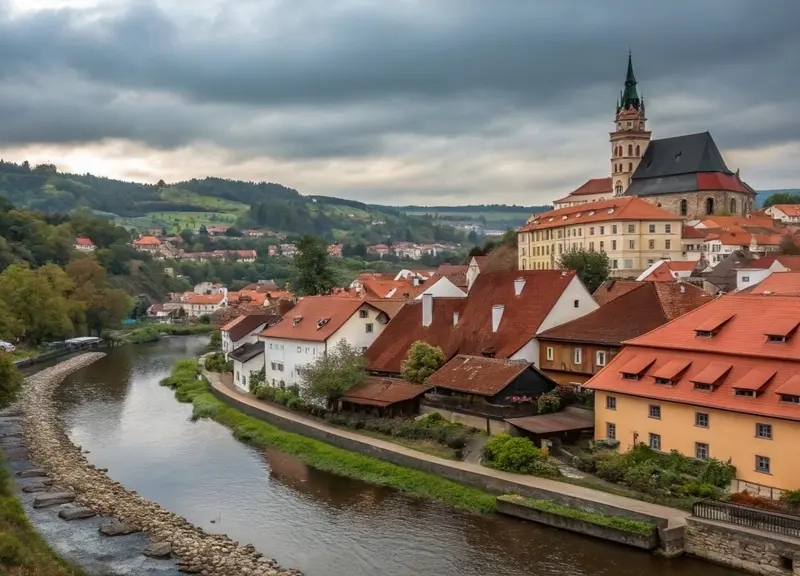

Czech language basics for travelers: phrases that will save you on the road

Czech language basics for travelers: phrases that will save you on the road
Published September 12, 2025|author: Andrii Vovk|Reading time: 12 min

Contents:

Why learn Czech before traveling?

Even basic knowledge of Czech can make a huge difference in your travel experience. Speaking the local language not only makes it easier to get around, buy tickets, or order food, but it also shows your respect for the country’s culture. Czechs are warm to tourists who make the effort to speak their language, so learning a few phrases can open up new opportunities for you, from extra friendly service to invitations to authentic local events. In addition, knowing the language gives you independence and helps you feel confident even in unexpected situations.

Mastering basic phrases in Czech has many benefits:

  • It's easier to establish contact: Czechs are always friendly to tourists who try to speak their language.
  • Avoiding misunderstandings: it is easier to explain your needs in transport, hotels or cafes.
  • Better service: knowing at least a few words often guarantees a warmer attitude.
  • Authentic experience: By speaking the local language, you will feel the atmosphere of the country more deeply.
  • Independence: you will be able to navigate cities, order food, and buy tickets without outside help.

Pronunciation and basic features of the Czech language

Before traveling to the Czech Republic, it is useful to familiarize yourself with the basics of local pronunciation. The Czech language is similar in structure to Ukrainian, but it has its own unique features that can be a challenge for beginners. Understanding the basics will not only help you better understand your interlocutors, but also sound more confident in everyday situations.

Czech belongs to the Slavic group of languages, so many words sound familiar. At the same time, there are also characteristic nuances:

  • The letter ř is a unique sound that is pronounced as a soft combination of “r” and “zh.” It is one of the most difficult sounds for foreigners.
  • The stress almost always falls on the first syllable of the word, which simplifies pronunciation for Ukrainian speakers.
  • The pronunciation of each syllable is clear : it is not customary to swallow or compress sounds, as is the case in English.
  • Vowels can be short or long , and this difference changes the meaning of the word. For example, “mám” (I have) and “mam” (mother).

Typical mistakes: Beginners often confuse long and short vowels, place the stress incorrectly, or miss the specific sound “ř”.

Examples of correct pronunciation:

  • Dobrý den [good day] — good day.
  • Jak se máte? [jak se mate] - How are you?
  • Na shledanou [na shledanou] — goodbye.

Even if your pronunciation is not perfect, Czechs are usually understanding and friendly towards your efforts. Don't be afraid to speak up - sincerity is valued above all else.

The most important phrases for travel

These phrases will come in handy literally everywhere: in a hotel, on public transport, on the street or in a shop. Knowing them means feeling more confident in an unfamiliar country.

Even if you speak English, Czech words can help you avoid language barriers in less touristy places, show respect for local customs, and make communication warmer. Czech language phrases worth learning before traveling will help you find a common language with locals more easily and feel more confident while traveling.

In this section, we have collected practical expressions that will help you in typical situations: from simple greetings to calling for help. Once you master them, you will be prepared for most everyday situations while traveling in the Czech Republic.

Greetings and farewells

First impressions in communication are always formed through greetings and farewells. In the Czech Republic, this is very important: politeness and proper address immediately open many doors. Knowing a few simple phrases will help you easily start a conversation, show respect for local residents and even get more help or a friendly attitude. This is especially important when addressing strangers, in hotels, shops, restaurants and even in transport.

  • Dobrý den — Good afternoon in Czech.
  • Good evening - Good evening.
  • Ahoj / Čau — Hello in Czech (informal greeting among friends and young people).
  • Zdravím — Greetings (formal or semi-formal address).
  • Nice to see you .
  • Jak se máš? — How are you? (informal).
  • Jak se máte? — How are you? (formal).

Farewell phrases:

  • Na shledanou — Goodbye.
  • Good night .
  • Sbohem — Goodbye (formal farewell).
  • Adieu — Goodbye (a less commonly used formal farewell).

Tip: In the Czech Republic, it is important to look the other person in the eye when greeting or saying goodbye, and accompany your words with a friendly smile. This is a gesture of sincere respect that is especially appreciated by the locals.
Czech words for asking about directions

Czech words for asking about directions

When traveling, an unfamiliar city can seem like a real maze, especially when you urgently need to find a hotel, museum or transport stop. In such cases, the ability to ask a simple question in Czech can be a real salvation. Most Czechs react positively to attempts by foreigners to address them in their language and are happy to help. These basic phrases will help you not to get lost and confidently navigate any settlement in the Czech Republic.

  • Kde je…? — Where is…?
  • How do I get to…? — How do I get to…?
  • Is it far away? - Is it far?
  • How long will it take? — How long will it take?
  • Can you show me on the map? - Can you show it on the map?
  • Is there a direct path? — Is there a direct path?
  • Is there a shorter way? — Is there a shorter way?
  • Is there a pedestrian zone? — Is there a pedestrian zone there?
  • Is it safe to walk there at night? — Is it safe to walk there at night?
  • Is there a parking lot? - Is there a parking lot?

Tip: always be polite: say Prosím (please) or Dobrý den (good afternoon) before asking a question - they will be more willing to help you.
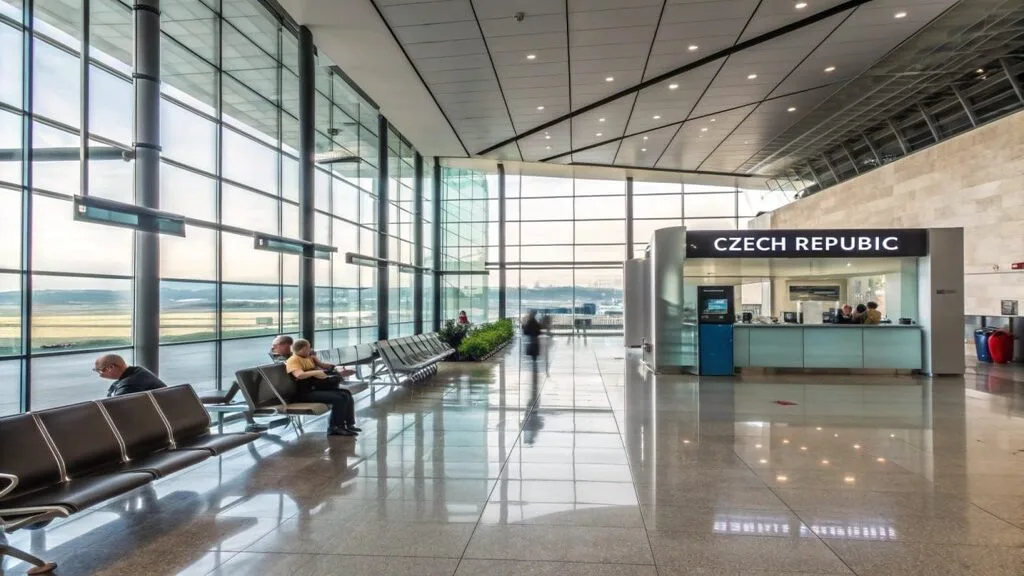
Czech language at the airport

Czech language at the airport

The airport is one of the first places you may encounter a language barrier when traveling. Clear communication will help you avoid confusion during check-in, boarding, or baggage handling. Even a few basic phrases in Czech will help you get your bearings, get help, and leave a good impression. It's important to remember that at major airports, staff often speak English, but at regional airports, it's better to have a few useful phrases ready.

  • Good afternoon, I would like to check in my luggage.
  • Where can I find the check-in counter for my flight? — Where can I find the check-in counter for my flight?
  • Is there a flight delay? — Is there a flight delay?
  • Kde najdu toalety? — Where can I find toilets?
  • Where can I find the information desk? — Where is the information desk located?
  • Can I charge my phone here? — Can I charge my phone here?
  • Where can I find the bus stop to the city center? — Where can I find the bus stop to the city center?

Tip: if you have a difficult situation (for example, lost luggage), be sure to start the sentence with Prosím (please) - this will help you get polite help faster.
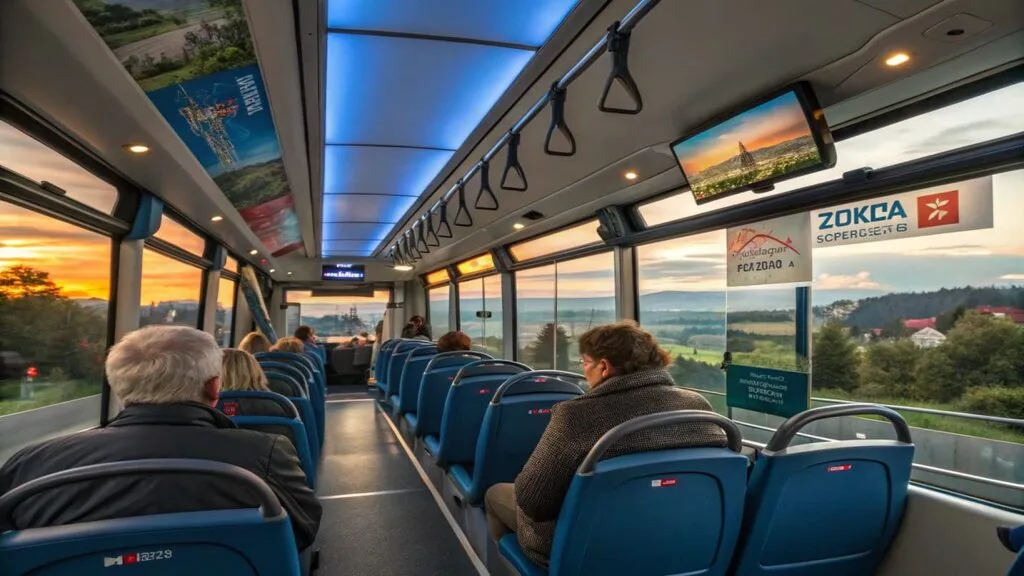
Czech in transport (bus, train, taxi)

Czech in transport (bus, train, taxi)

Transport is one of the most common areas where tourists need to express their requests quickly and clearly. Buying a ticket, checking the schedule, hailing a taxi or finding out about the next stop - in all these situations, basic phrases in Czech will help to avoid confusion and stress. This is especially true outside of large cities, where not all transport workers speak English. Knowing a few key phrases will make your trip much more comfortable and safer.

  • Jízdenka, prosím — Ticket, please.
  • How much does a ticket to [place name] cost? — How much does a ticket to [destination] cost?
  • Where do I get off at [stop name]? — Where do I get off at [stop name]?
  • Please stop at the next stop.
  • Can I order a taxi? — Can I order a taxi?
  • Where is the nearest bus/train stop? — Where is the nearest bus/train stop?

Tip: when asking a question to a driver or inspector, be sure to use the words prosím (please) and try to accompany your question with a polite smile - this is a common norm of communication in the Czech Republic.
In cafes and restaurants

In cafes and restaurants

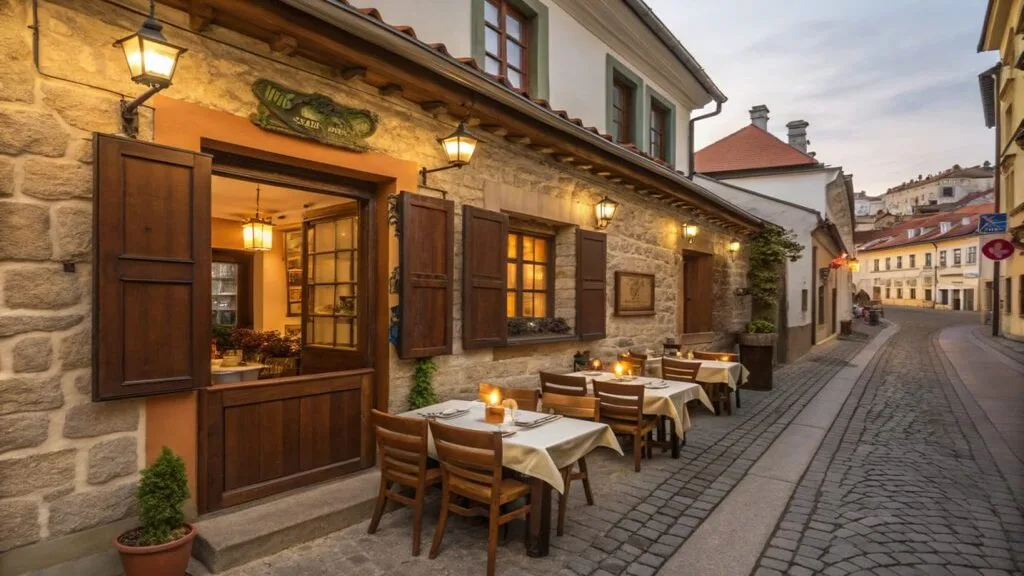
Czech cuisine is worth discovering in cozy cafes and traditional restaurants. To make ordering food easy and without misunderstandings, it is important to know a few basic phrases in Czech. This will not only allow you to place an order without any problems, but also show respect for the country's culture. Often, waiters in popular tourist places speak English, but addressing them in Czech will arouse sincere sympathy and may provide even better service.

  • Do you have a free table for [number of] people? — Is there a free table for [number of] people?
  • I would like to reserve a table for [time ].
  • — Can I have a menu, please ?
  • I would like to order [name of dish] — I would like to order [dish].
  • Invoice, please.

Typical Czech dishes worth trying:

  • Svíčková na smetaně — marinated beef in a creamy sauce.
  • Guláš is a Czech version of Hungarian goulash.
  • Knedlíky are traditional Czech dumplings to accompany meat dishes.
  • Pilsner is a legendary Czech beer.

Tip: if you have special dietary requirements (gluten-free, vegetarian menu), don't hesitate to specify this in advance - it's better to use the phrase Máte bezlepkové/vegetarianánské jídlo? (“Do you have gluten-free/vegetarian food?”).
In a hotel or hostel

In a hotel or hostel

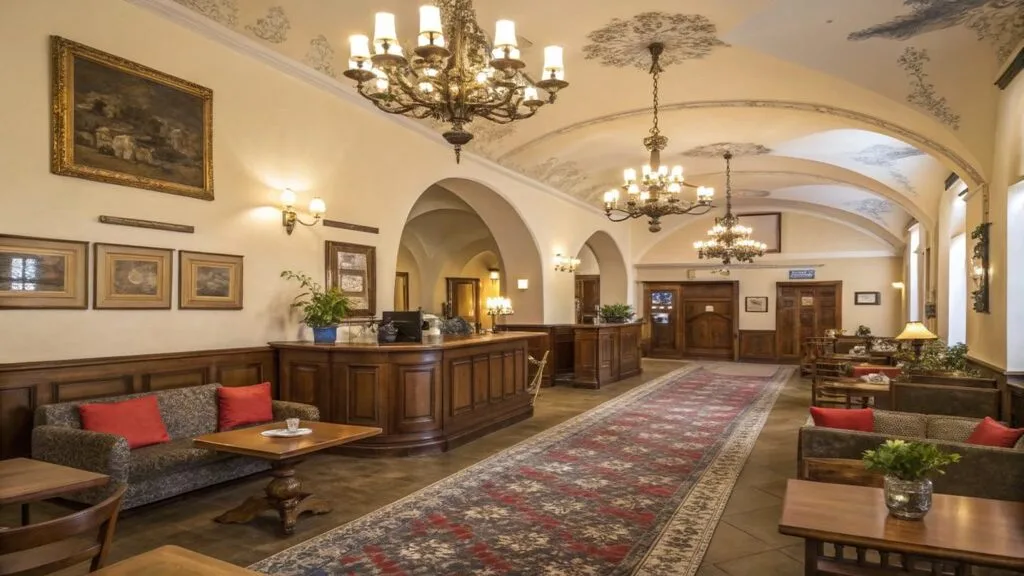
After a long journey, arriving at a hotel or hostel is the first opportunity to relax and feel "at home". To make the process of registration, settling in or resolving everyday issues go smoothly, it is worth knowing a few basic phrases in Czech. In many hotels, the staff understands English, but in smaller establishments, especially outside of large cities, knowing at least basic Czech will make a good impression and make your stay easier.

  • Good afternoon, I have a reservation in the name of [your last name].
  • Mám rezerváci na [date] — I have a reservation for [date].
  • Jsem tu na služební cestu — I am here on a business trip.
  • I am here on vacation.
  • I would like a room with [room requirements] — I would like a room with [room requirements].
  • Potřebbuji pokoj pro [number of people] osob — I need a room for [number of people] people.
  • Mohu zaplati kartou? — Can I pay by card?
  • What is the Wi-Fi password? — What is the Wi-Fi password?

Phrases in the room:

  • Can I have more towels? — Can I have more towels?
  • I need toilet paper.
  • Can you change the bed linen? — Can you change the bed linen?
  • Mám rozbitou žarovku — My light bulb has burned out.
  • My TV doesn't work.

Tip: if you have a problem with your room, politely contact the reception, starting the conversation with Dobrý den, prosím vás - in the Czech Republic this is considered good manners and speeds up the resolution of the issue.

In the store or at the market

In the store or at the market

Shopping at local markets or stores is a great opportunity to get to know the life of Czechs better and buy unique products. To avoid misunderstandings and easily navigate prices, assortment and payment terms, it is worth knowing a few basic phrases in Czech. In addition, polite address in the local language often helps to get better service, nice bonuses or discounts.

  • Hledám [product name] — I am looking for [product name].
  • Do you have [product name] in [color]? — Do you have [product name] in [color]?
  • Jaká je cena [name of product]? — How much does [name of product] cost?
  • Can I look at this? — Can I look at this?
  • I want to buy it.
  • Do you accept cards? — Do you accept cards?
  • Kde najdu pokladnu? - Where is the cash register?

Tip: It is not customary to haggle in Czech markets, but friendly and polite communication often brings pleasant “bonuses” - for example, a gift or a small discount.
In case of an emergency

In case of an emergency

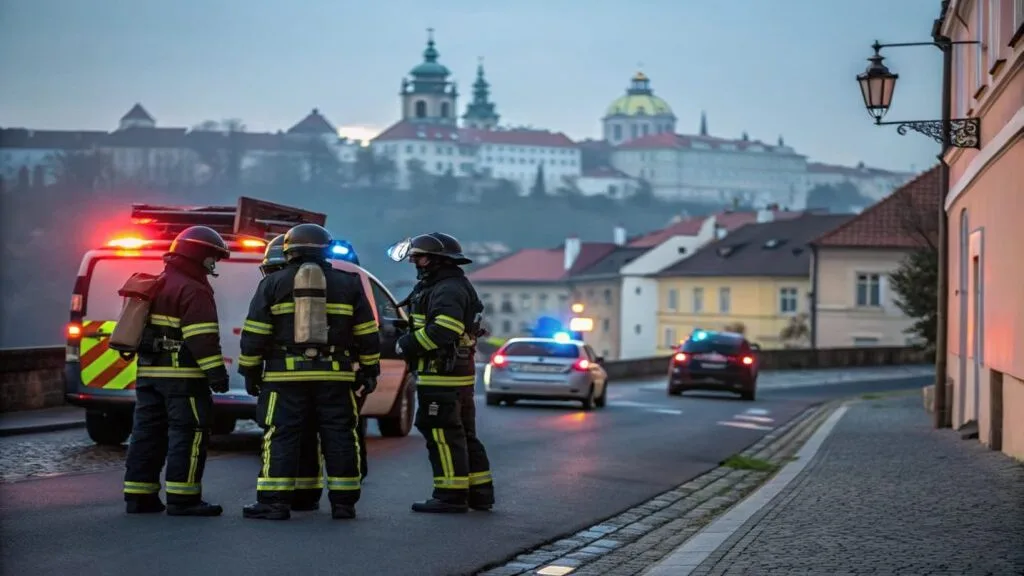
When traveling, even in the safest countries, unforeseen circumstances can arise - from losing documents to the need for medical assistance. In critical moments, it is important to be able to quickly and clearly explain your problem to the locals. Knowing a few basic Czech phrases will help you contact the police, doctors, or simply ask a passerby for help. Don't worry about possible language errors: a sincere desire to communicate will always be perceived positively.

  • I need medical help.
  • Where is the nearest hospital? — Where is the nearest hospital?
  • I feel bad - I feel bad.
  • Mám horečku - I have a fever.
  • Bolí mě [body part] — I have [body part] pain.
  • Ztratil/a jsem pas — I lost my passport.
  • Please call the police! — Please call the police!
  • Pomozte mi, prosím! — Help me, please!

Tip: if the situation is urgent, it is worth starting the appeal with the word Pomoc! (Help!) - this will immediately attract the attention of those around you.

Useful tips from LikeBus for learning Czech phrases for travel

Even if you have very little time left before your trip, learning basic Czech phrases is possible without any stress. The main thing is to use the right resources and methods that will allow you to quickly memorize the necessary words in a practical context. We have collected for you the most effective tips that will help you learn key phrases for travel and feel confident in any situation in the Czech Republic.

  1. Mobile apps: Use platforms like Duolingo, Mondly, or Drops to practice basic phrases.
  2. Audio phrasebooks: listen to ready-made sets of phrases in your headphones while commuting or walking.
  3. YouTube lessons: subscribe to channels specializing in Czech for beginners.
  4. Printouts: Prepare a pocket note with essential phrases and carry it with you.
  5. Association method: associate new phrases with visual images or specific situations.
  6. Repetition out loud: say phrases several times a day - this helps to better consolidate knowledge.

Practice new phrases every day for at least 10 minutes - this will significantly increase the chances of easily remembering the necessary words during your trip.

Conclusion

Learning a few phrases in Czech is a small investment of time that will pay off many times over during your trip. The Czech language, whose words often resemble Ukrainian, can be quite understandable for travelers even at a beginner level. You will be able to find a common language more easily, receive better service and experience the unique atmosphere of the Czech Republic more deeply. Start simple - learn greetings, basic questions and thanks - and let your trip be comfortable, safe and unforgettable with LikeBus!
Author:

Andrii Vovk
Travel expert
Visited 20+ countries, speaks 5 languages, knows where to find the cheapest tickets and how to cross half of Europe with one backpack.

Recommended articles

Luggage rules on international buses
Travel tips • Reading time: 11 min
Luggage rules on international buses
International bus transportation remains one of the most popular ways to get to European countries. It combines accessibility, route flexibility, and the ability to travel comfortably with a large amount of luggage. However, in order for the trip to be as comfortable and safe as possible for all passengers, it is important to know the rules for transporting luggage on the bus. Each carrier has its own list of baggage rules and requirements – weight, dimensions, content restrictions. This is not a formality, but an important safety component: excessive or improperly packed baggage can interfere with evacuation, block aisles, or pose a risk of damage to other passengers’ belongings.
Andrii Vovk • September 30, 2026
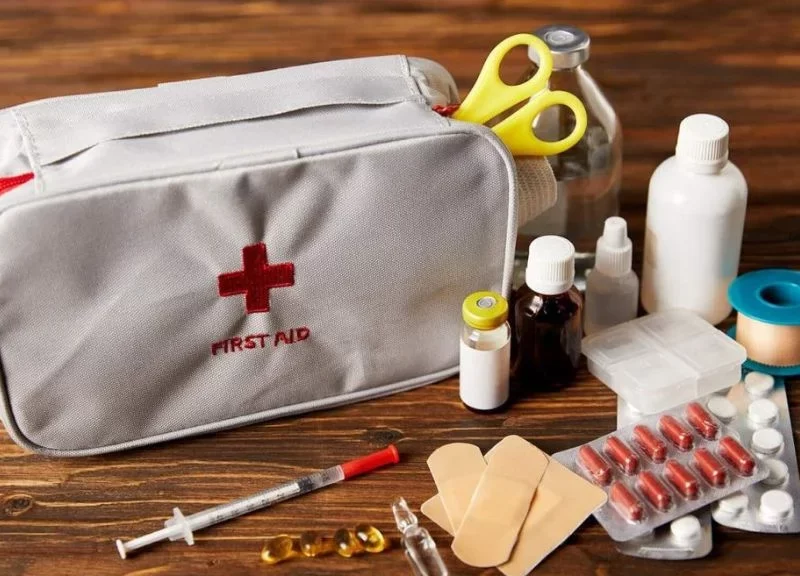
What to put in a travel first aid kit: tips for traveling by bus?
Travel tips • Reading time: 14 min
What to put in a travel first aid kit: tips for traveling by bus?
Updated 08/28/2026. The composition of the road first aid kit for adults and children has been clarified, recommendations for rehydration, allergies, motion sickness, and emergencies have been added. The rules for storing and transporting regular, prescription, injectable, and controlled drugs across the border have been updated. Important: the material is for informational purposes only and does not replace medical advice. The choice of drugs, dosage, and possible contraindications should be checked individually. Traveling by bus can be exciting, but long journeys, changes in diet, motion sickness, and unforeseen situations can ruin the experience if you don't take care of your health in advance. One of the key stages of preparation is a properly assembled first aid kit for the trip. Its contents depend on the duration of the route, the country of destination, the passenger's age, health status and the availability of medical care along the way. In this article, we will consider what should be in a travel first aid kit, how to store medications and what rules for their transportation should be taken into account.
Andrii Vovk • September 30, 2026
🚌 Always in touch with your trip
⏱ Running late 📍 GPS 🎁 Bonuses
Download
Contact by phone
Ticket booking +38 (098) 343-82-82
Support +38 (050) 082-82-82